Kristen Torre's Professional Portfolio
Work Samples
Below are examples of instructional design projects that have been created throughout my graduate program of Instructional Design and Technology. The examples below that showcase numerous skills I have gained throughout my time studying instructional design and technology.

01
Action Research Plan
"Educational research provides a vast landscape of knowledge on topics related to teaching and learning, curriculum and assessment, students’ cognitive and affective needs, cultural and socio-economic factors of schools, and many other factors considered viable to improving schools," (Clark et al, n.d.). This action research plan looks into phonemic awareness and phonics intervention program, FastBridge, for primary students to determine the validity of the program and the how the dosage of the intervention for student corresponds to their grade-level assessment.
02
Creating a Classroom Community: A Constructivist Course Design Project
Instructional design involves creating trainings, courses and modules from school aged learners all the way through adult learners. In this project, I designed an online professional development course for elementary educators focused on inquiry based learning strategies to implement in the classroom. This course was designed using the constructivist learning theory where learners are asked to apply their knowledge they have gathered from prior experiences, peers, and informational resources to construct their understanding of the content and apply their knowledge. This design plan was created following the 5E's model which includes: Engage, Explore, Explain, Elaborate, Evaluate (5E's model of instruction, n.d.).


03
NASA Space Program: An ADDIE Course Design Project
In this course, I was tasked with creating a unit for a first grade classroom following the ADDIE model of design. I documented my process and design outline in the attached PDF. I used Schoology as my LMS to construct a unit of study on space where students in my classroom would have to "apply for a NASA Kids Program," then have the opportunity to learn from four different scientists within the NASA program. On page 20 of the PDF, there is a link to a video walk through of the space unit on Schoology.
04
Collaborative Storyboarding
Collaboration is of the utmost importance as an instructional designer. Whether it is working with a Subject Matter Expert (SME) or fellow instructional designers, collaboration and communication must be strong in order to create an effective product. In this storyboard assignment, I worked with a group of fellow designers to develop a training module based upon cyber security. The storyboard is linked to the first button and the evaluation tool created, is linked to the second button.


05
LMS Comparison Analysis
This project had leaners look at four various Learning Management Systems (LMS) analyze them as though I was presenting them to the district for consideration. I chose to look at Schoology, Blackboard, Canvas, and Moodle to determine how they could be used in a K-12 school setting. I researched the user guides for each of the LMS and created a PowerPoint presentation with a voice over going through the presentation as though I would be giving it to fellow colleagues.
06
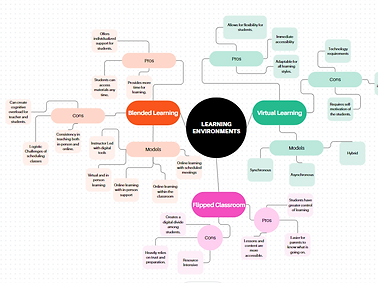
Learning Environments Mind Map
Traditional learning environments where students and teachers are in the same room when information is shared and learning is assessed have shifted due to the availability and convenience of technology. Three types of learning environments include: virtual learning, blended learning, and flipped learning. These learning environments allow users to access learning at home or revisit information as needed. This mind map and document look at each of the three learning environments while identifying the pros and cons of each.
07
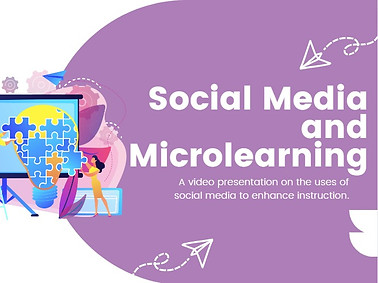
Social Media and Microlearning Video
Microlearning allows learning to be delivered to the audience in focused chunks of information (What is microlearning, n.d.). Information in microlearning contains one objective the lesson is trying to teach. By keeping the information specific to the learning objective, learners information can be delivered in short bursts, such as through social media. This video describes microlearning and the role social media has played to promote this type of learning.
08
Web 2.0 Infographic
Web 2.0 shifts the use of the internet from a search platform with read only sites and sources to a platform that allows for social interaction with users through the use of networking, cloud computing, and content creation (Hosch, n.d.). This infographic explores the uses of Web 2.0 tools that can be used to promote learning and collaboration amongst peers.
